Math Games
Three ways to think through a math game
A calculation can be the entire challenge, or it can give you a clue about where a piece belongs. The Math collection on Pokia includes both approaches. Choose a grid when you want to weigh several possibilities at once, an expression when you want to practice a clear sequence of steps, or a matching game when you want to test how readily familiar number pairs come to mind. These formats ask for different kinds of attention even when they use the same arithmetic.
Use the crossing equation as a check
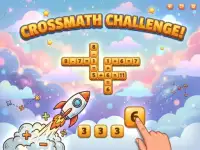
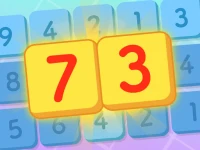
In CrossMath Challenge, you drag number tiles into a grid where equations read across and down. Think of a shared square as a meeting point between two clues. If the horizontal equation needs a six, try that value in the vertical equation before treating the space as settled. If the vertical result fails, retrace the calculation that looked more uncertain. This is especially helpful when two rows seem to need the same tile. Start with the equation that has fewer empty places or gives you a value you can check immediately.
For example, if two missing numbers must add to nine, there are several plausible pairs. A crossing clue that fixes the first number at four turns the second into five. The advantage comes from choosing where to start. It can be quicker to work from the narrow clue and then return to the open one than to keep trying pairs in isolation. That change of direction is part of what makes an arithmetic grid interesting after you already know the basic sums.
Read the whole expression before answering
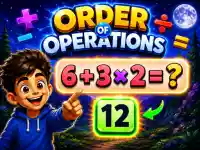
Order of Operation Challenge puts the focus on the order in which you perform each calculation. Look for parentheses first and keep track of the expression that remains after you simplify them. You can practice the idea with two short expressions. Two plus three times four gives fourteen because the multiplication comes first. Put parentheses around two plus three and the result becomes twenty. The numbers have stayed in the same places, but the grouping changes the answer. If you rush, a perfectly correct multiplication can still lead you to the wrong result.
Remember a position and a relationship
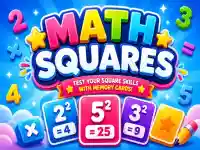
Math Squares makes you match a number with its square using memory cards. Seeing seven should bring forty nine to mind, but that only helps you make a match if you remember where the other card was. Try giving each turn a specific job. If you uncover a new square, work backward to the base and remember the location together with that pair. If you recognize a base whose partner has already appeared, recall the position before turning another card.
To make a short session varied, start with a few pairs in Math Squares and switch to a CrossMath grid. Notice how often you recall an answer immediately and how often you infer it from what is already on screen. Save the expression game for a round where you can concentrate on the signs. A single missed set of parentheses is a concrete clue about what to watch for on the next expression.